Existing aluminium joinery, Auckland-wide
Double glazing for Auckland's aluminium windows
Aluminium double glazing in Auckland is mostly a retrofit job. The joinery stays on the house and the installer swaps the single pane for a sealed unit. Whether that works depends on how deep the section is, not how old it is. Leave your name and number and an Auckland installer will ring you to set up a measure.
Get a quoteIf it's the frames that run wet rather than the glass, double glazing won't fix that. It warms the glass and does nothing for a standard aluminium frame.
Why 1960s to 90s aluminium joinery suits a retrofit
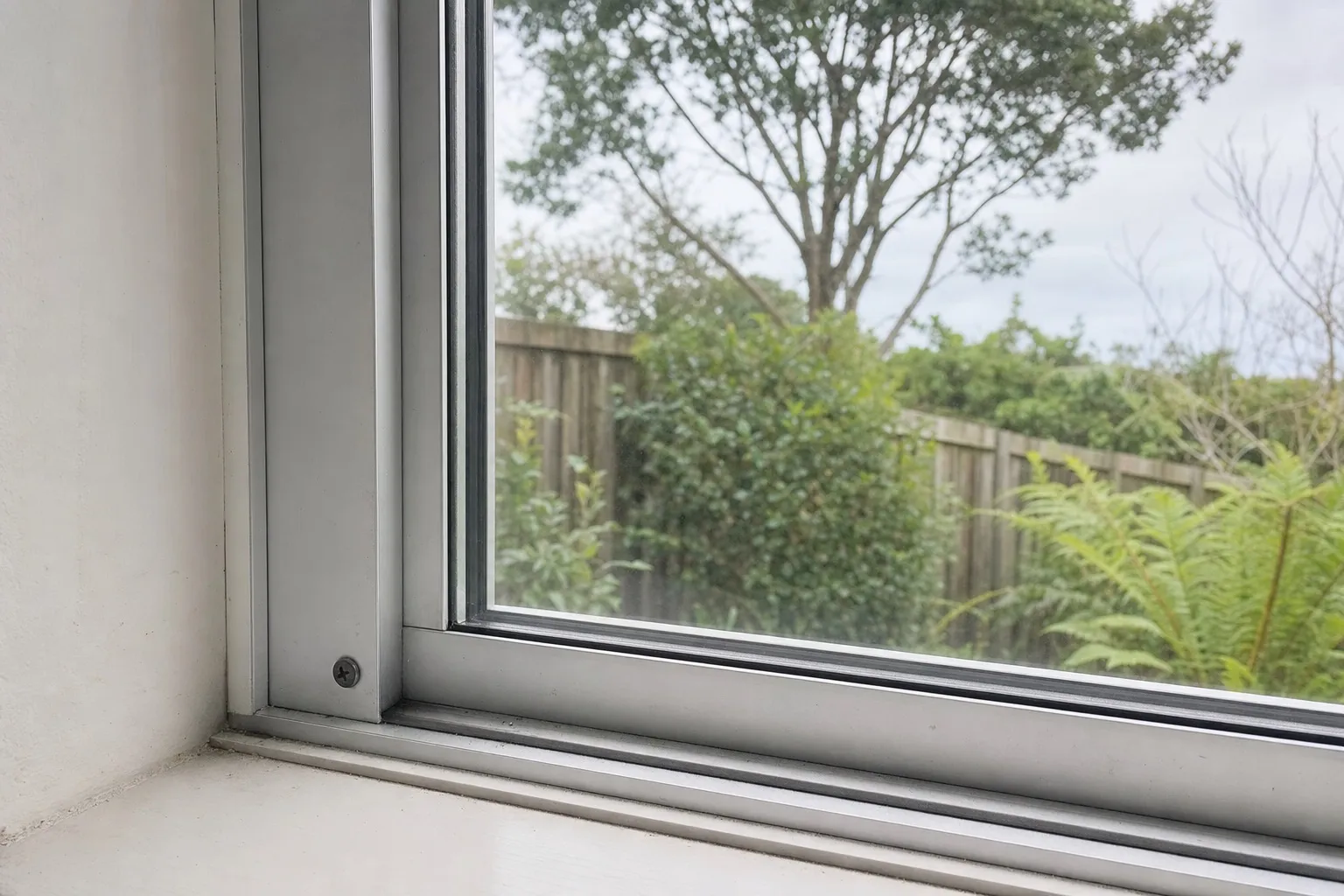
A lot of Auckland houses got aluminium joinery between the 1960s and the 1990s, and most of it still works. The frames don't rot, they're usually still square, and most sections from those decades have room for a sealed unit or an adaptor bead. There's usually nothing to repair before the glass goes in.
The climate is the other reason. Auckland Airport records about nine ground frosts a year, so a frame here is hardly ever frozen. But the air at nine in the morning is 82% humid across the year, and 88% in July. On those mornings single glass in a metal frame is the coldest surface in the room, so that's where the water streams. A sealed unit keeps the inner pane near room temperature.
Double glazing became effectively required on new Auckland homes from 30 September 2008, so joinery from before then is probably single glazed unless it's already been done. If the house has timber sashes as well, both kinds of window can go on the same quote.
82%
humidity at 9am at Auckland Airport, across the year
1 in 6
Auckland homes with mould
R0.24
standard double glazing in a standard aluminium frame, code reference table
When the section is too shallow for a unit
Every aluminium frame has a channel the glass sits in. A single pane needs very little of it and a sealed unit needs a lot more. Some of the slimmer sections on older houses don't have that much.
If the channel is a bit short, an adaptor or a deeper bead clipped to the frame makes up the difference. That's how most retrofits into aluminium are done. If it's far too shallow there's nothing to fix a bead to, and the window has to be replaced. A twisted sash rules a frame out too, because a rigid unit won't sit flat in it, and so does a bottom rail with no working drainage.
Then you're looking at replacing the window, either with new aluminium joinery in the same opening, with or without a thermal break, or with uPVC. On a house of up to two storeys, new windows in the same position don't need building consent.
Standard or thermally broken, in Auckland's climate
A standard aluminium frame is one piece of metal from the outside face to the inside face, so the inside face runs close to the outside temperature. A thermally broken frame has a strip of low-conductivity material between the two halves, so the inside face stays warmer.
The Building Code's reference table gives the figures. Standard double glazing rates R0.24 in a standard aluminium frame and R0.30 in a thermally broken one. With low-E and argon the two are R0.35 and R0.46. For new homes in Auckland's climate zone, the current H1 method designs against a reference building with R0.46 windows. An existing house doesn't have to reach that, because replacement joinery only has to perform at least as well as what it replaces.
A retrofit into a standard frame stops the glass running wet, but the frame will still sweat on a cold, damp morning. If wet frames and mould on the sills are the main complaint, only a thermal break, uPVC or timber fixes the frame itself, and those cost a lot more per window. There's more on why the frame gets wet when the glass doesn't.
Standard aluminium frame
The metal runs straight through, so it sweats on a damp morning even with double glazing in it.
Thermally broken frame
A strip of low-conductivity material separates the two halves, so the inside face stays warmer.
Wet frames, wet glass, or both?
Leave your name and number and the installer will ring to work out whether a retrofit gets you what you want or the frames need to go.
Ranchsliders, doors and bathroom windows
All three need safety glass. That puts the price up, and sometimes it means replacing instead of retrofitting.
-
Ranchsliders
A slider can be retrofitted if the sash and track have room for a thicker, heavier unit and the rollers will carry it. An old ranchslider usually isn't worth it. The track is worn, the sash is already heavy, and door glass has to be safety glass, so the unit costs more than a window's.
-
Doors and side panels
Glass in a door, and in a panel beside one, has to be safety glass under NZS 4223.3. So does anything low enough that someone could fall into it, and the standard's scope runs to glazing within 2,000 mm of the floor or ground. The units are toughened or laminated, so they're heavier again and cost more than a plain window unit.
-
Bathroom and stairway windows
The same standard covers bathrooms and stairways. A plain pane there may have to be upgraded to safety glass when it's replaced, even though the job needs no building consent. The installer matches obscure glass as closely as they can to what's there.
What it costs per window in Auckland
Prices are per window, not per pane. There are figures for a whole three-bedroom house too, and more on how a retrofit job runs.
- Retrofit, standard window~$400–800
- Retrofit, large living-area window~$800–1,500
- New window, standard aluminium~$1,200–2,700
- New window, thermally broken~$2,000–3,500
- New aluminium sliding door~$4,500–7,000
Published Auckland installer pricing for 2026. Most sources don't say whether GST is included, so ask before you compare a quote.
Questions about aluminium double glazing
Can aluminium windows be double glazed?
Most can. The frame needs a channel deep enough to hold a sealed unit, or close enough for an adaptor bead to make up the difference, and it needs to be straight with working drainage. Slim older sections with nowhere to fix a bead get replaced instead.
Is aluminium double glazing good?
In a sound frame, yes, with one limit. A retrofit fixes the glass, but a standard frame stays one piece of cold metal and can still run wet on a damp morning. If the frame is the complaint, a thermally broken frame means replacing the window.
How much does a double glazed aluminium window cost?
On published 2026 Auckland installer pricing, a retrofit into an existing frame is about $400 to $800 for a standard window and $800 to $1,500 for a large one, and a new window is roughly $1,200 to $2,700 in standard aluminium or $2,000 to $3,500 thermally broken. There's a fuller breakdown of double glazing costs in Auckland.
What are the disadvantages of aluminium windows?
The frame conducts heat, so it runs cold and wet on a damp morning even when double glazing keeps the glass dry, and mould on the sill follows. The Building Code's reference table rates standard aluminium lowest of the common frames, R0.24 with standard double glazing against R0.37 for uPVC and R0.41 for timber. On the plus side, aluminium doesn't rot.
Find out what your aluminium windows will take
Send your name and number and the installer will ring to book a measure. Ask for the quote per window, not per pane, so it lines up with the published figures.